home

Poverty in Cancun

June 7th, 2009

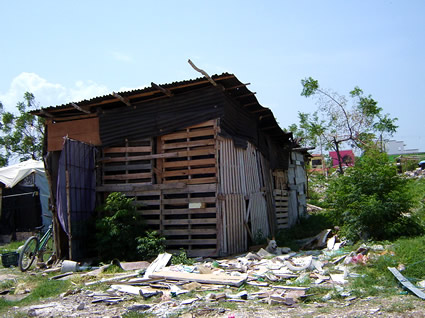
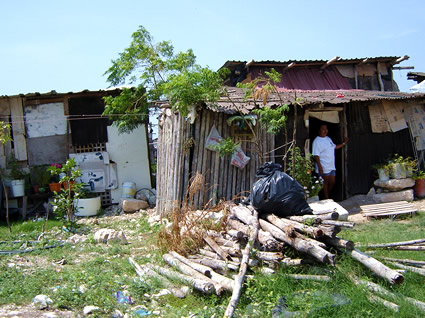
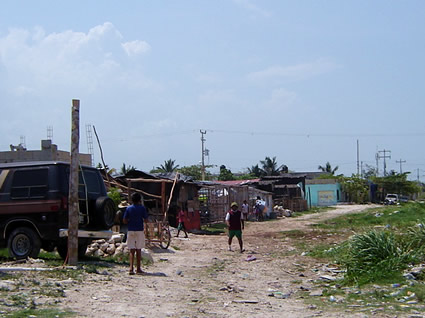
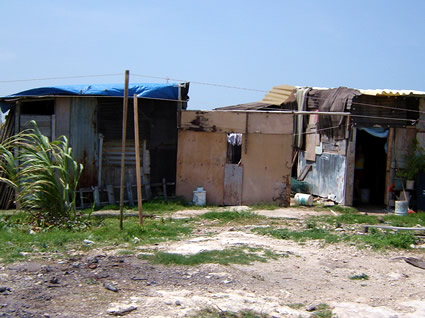
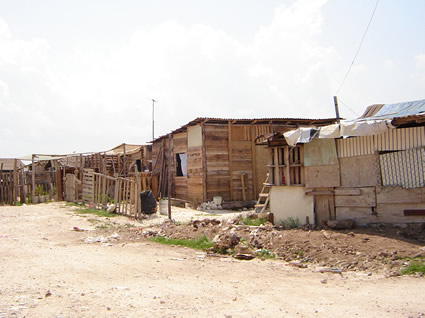
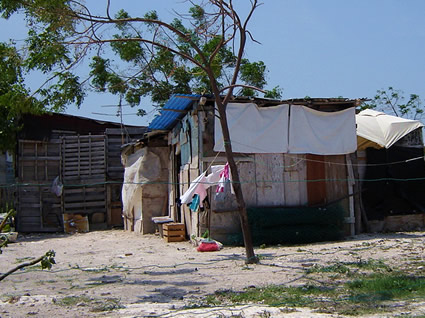
We were driving home from the beach at Isla Blanca the other day and ended up passing through a very, very poor area on the north side of Cancun. I thought I would share some of the photos I took.

Next time someone tells you that there isn’t real poverty in Cancun you can tell them they are dead wrong. By the time we drove out of this area I was in tears. I can’t imagine raising a child in a place like this.

Poverty in Cancun Mexico

Poverty in Cancun Mexico

Poverty in Cancun Mexico

Poverty in Cancun Mexico

Poverty in Cancun Mexico

Poverty in Cancun Mexico

If you are interested in finding ways to help fight poverty in Cancun I recommend getting in touch with the City of Joy Foundation (Fundación Ciudad de la Alegría, A.C.). City of Joy Foundation has a number of effective programs that work to help Cancun’s poor.

Learning about the Massacre in Tlatelolco

May 17th, 2009

The other day my husband brought home the movie “Rojo Amanecer” for us to watch. The title means “red dawn” in English, but this isn’t the cheesy American-made Red Dawn movie about the U.S. getting into WWIII with the Soviet Union. Instead this is a Mexican movie about the 1968 Massacre in Tlatelolco, a neighborhood in Mexico City.

My husband lived in Tlatelolco as a child. He took his First Communion in the church of Santiago Tlatelolco right there in the Plaza de las Tres Culturas, where the massacre began. And for years he has been telling me bits and pieces of what he remembers of that night. Mostly what he seems to remember is the sound of the tanks rolling in and falling asleep to the sound of endless gunfire. He told me that it took him a long time to fall asleep that night and that “the gunfire went on and on and didn’t stop.” I can’t imagine what that must have been like for a young child.

The movie Rojo Amanecer won a Silver Ariel award and starred important Mexican actors. It was and is an important movie. It’s also cheesy as all get-out, with nearly non-stop over-acting and unrealistic-looking and generous displays of ketchup. Its characters also have an incredible number of meals in a short amount of time, they never stop eating. But when I watched it what I was seeing was a missing piece of my husband’s childhood. I was learning something important about why he is the way he is and why he thinks the way he thinks.

Watching this movie taught me something about why so many Mexicans, especially my husband, don’t trust their own government. If a government can massacre a crowd, in the middle of it’s capital city, and then cover it up, what else can they do? I think that there is a whole generation of Mexicans who’ve grown up wondering just that. And I think this goes a long way to explaining some of the wild conspiracy theories that get passed around in Mexico. A whole generation of people don’t trust the government and won’t put anything past it.

I recommend Rojo Amanecer to anyone who is a student of Mexican culture or is an expat living here. It goes a long way towards explaining the very real fear so many people in Mexico have of their government’s power.

Swine Flu Fears in Cancun

April 30th, 2009

Swine flu isn’t here yet. As I write this we have no confirmed cases of Swine Flu in Cancun. But everyone is sure acting like it’s already here. I won’t bore you with details since my friend CancunCanuck has already laid it all out. Suffice to say that Mexican authorities are working very hard to stop the spread of this flu.

I’m getting emails every day from tourists wondering if they should cancel upcoming vacations to Cancun or the Riviera Maya. I’m telling everyone to wait as long as they can to make those decisions.

Something which has become clear to me in the last week is that Mexico has a significant lag time between finding a flu case “suspicious” and getting actual confirmation that a case is or is not Swine Flu. The reason for this is that there is not a lab in all of Mexico which can properly identify Swine Flu. So all samples have to be sent out of the country for identification and that takes time.

I don’t know how fast Swine Flu cases in the U.S. or Canada are confirmed, but I’ll bet it’s faster than here in Mexico. And I’m worried that this difference in identification time is skewing the data. Data which is being used by all sorts of people to make all sorts of decisions.

The fatality rate of the Swine Flu probably can’t be extrapolated until more cases are confirmed. And it’s likely that many cases in Mexico are simply not going to be reported at all, because they were so mild as to not warrant a hospital visit. Many are suspecting that when the data is fully collected this flu may not be more dangerous (in its present mutation) than a “regular” flu. But time and data will tell us this.

In the mean time I continue to tell tourists the truth, which is that it’s not here yet. And I continue to encourage them to wait as long as possible to make their decisions to change or cancel their trips to Cancun. There will only be more data later.

Easing of Cuba Travel Restrictions Will Cut Bribe-Taking in Mexico

April 13th, 2009

Today the Obama administration lifted the travel restriction for Cubans traveling to Cuba from the U.S. This will have the effect of helping to cut bribe-taking in Mexican Immigration in Mexican cities with direct flights to Cuba.

Under the old rules Cubans who wished to travel from the U.S. to Cuba more often than they were allowed to under U.S. law would commonly try to bribe Mexican Immigration officials to prevent the officials from stamping their passports with a second (and to U.S. officials suspicious) entry stamp.

The typical scenario worked like this: A Cuban (or an American traveling illegally to Cuba) flies to Mexico from the U.S. In Mexico their passport is stamped showing an entrance to Mexico via air on a certain day. Then the passenger generally travels on to Cuba the same day, on a later flight, never leaving the airport.

Cuba is known to be ‘nice’ to people in this situation, so Immigration officials there do not stamp these passengers’ passports, leaving no record of their entry to Cuba.

Returning to the U.S. the passenger flies back to Mexico where the Mexican Immigration official is required by law to place another entry to Mexico stamp in the person’s passport. U.S. Immigration officials know to look for two Mexican Immigration entry stamps within a short time frame, this alerts them that the passenger may have traveled from Mexico to Cuba.

And so upon return to Mexico from Cuba it is very common for Cubans who reside in the U.S., and for Americans who have traveled to Cuba illegally, to try to convince the Mexican Immigration officials not to give their passports that second suspicious Mexican entry stamp. As you can imagine, the convincing part often involves money changing hands.

It’s hard to blame Mexican Immigration agents for taking these easy bribes. The passengers are often VERY interested in NOT getting that second stamp and are willing to pay well to avoid it. And Mexico doesn’t pay its Immigration agents a living wage. Currently the pay rate for most agents is something around $8000 MXP per month after tax (which is less than $500 USD at current exchange rates).

With the cost of living here and that salary you can’t maintain a vehicle, let alone a decent home. People living on less than $500 USD per month here in Mexico can forget about anything except meeting their basic needs and an occasional stop at a street vendor for cheap tacos. There is no extra money in that equation, none. So it’s very easy to see why these poorly paid agents would be willing to take easy money from someone desperate to avoid having their passport stamped.

Taking a bribe is not without risk for an Immigration agent in Mexico. Agents have gone to prison for taking just a $20 USD bribe. But travelers rushing through airports are almost universally not interested in taking the time to report their abuse at the hands of Immigration officials. And if you are guilty of giving the bribe you are not about to turn yourself and the agent in, because you’ve received a benefit. So while there is a risk to the agents for taking bribes they know that their chances of getting turned in for bribe-taking are very small.

The easing of the U.S. travel restrictions to Cuba will mean that the Cubans, at least, who travel through Mexico en route to Cuba, will have no reason to try to bribe Mexican Immigration agents. This is good. Other Americans, who are traveling to Cuba illegally will still have reason to avoid that second stamp, however. So the corruption will be reduced but will continue.

Until such time as Mexico sees fit to pay its Immigration agents a decent salary, a salary that represents a wage that allows more than just subsistence living, many agents will embrace the easy money that is a side-effect of illegal travel to Cuba by Americans.

For Mexico’s sake, it is my hope that the U.S. will completely remove the restrictions on U.S. citizens traveling to Cuba. This would completely eliminate a huge source of bribe money for Mexican Immigration agents. I also hope that the Mexican government will recognize that it can’t hope to fight corruption in Mexican Immigration until it pays those agents a decent wage.

Telling You What You Want To Hear

April 11th, 2009

This is also known as lying to you and it’s an institution here in Mexico.

Ever since I moved to Mexico I’ve been noticing that people would tell me one thing and then go off and do another. This happens with construction workers, with acquaintances, with store employees, it happens all through out society here from what I can see. The first few times it happened to me I was incredulous. Surely being culturally sensitive to and adapting to my new country didn’t mean I had to put up with this kind of bullshit?!? Ah, but it did.

After a few years I began to see that people here tell you what you want to hear because it’s polite. Or because it would be impolite to tell you what you don’t want to hear. Either way it amounts to people saying things are possible when they are not, and telling you that they will make things happen which won’t ever happen.

Recently my husband and I had two experiences back to back in which we were the very frustrated victims of people here telling us what we want to hear.

In one case numerous Bancomer bank employees promised us something over and over, which in the end, after waiting patiently for 4 weeks, didn’t happen. When we challenged the bank, telling them that x, y, z employees had told us this would happen Bancomer came back with “let’s review it again, it should happen,” which leads to another 3 week review process (which we are still in the middle of). At this point I’m just about certain that Bancomer’s strategy is to wear us out so we give up the fight.

We had another experience where we hired an attorney to do some work for us. There were 2 possible routes to resolving our legal issue. One route involved a slow-as-molasses process that involves filing gobs of papers with the Cancun city government. We decided against this route because the lawyer stated that his other proposed route would net results much faster. We met with the attorney on a Friday and he said he could do the needed work the following Monday. That was over 3 weeks ago. And so far the lawyer hasn’t done the work we’ve paid him for. But does he tell us what’s going on? No, he tells us what we want to hear (when he answers the phone).

Now I appreciate that people do not want to hurt me by having to tell me things are not possible. I appreciate that being the bearer of bad news is not polite in Mexico. But where I come from NOT telling people the reality of their situation is extremely impolite. And lying to people is RUDE. So it has been a big adjustment for me to learn not to just get mad when I find someone telling me just what I want to hear. I’ve learned not to believe things until I see them. And I’ve learned to listen for a “yes” that comes to easily.

My Word Cloud

March 21st, 2009

I got this idea from Joyce (thanks girl). The image below is a Wordle that was created using the words I commonly write on this blog…not too many surprises here:

Running for Charity

March 21st, 2009

My fellow ex-pat blogger Gary Denness, aka The Mexile, who blogs from Mexico City, is going to run the Mexico City Marathon 2009 this year and he’s raising money for charity in the process. The charity he’s chosen is Wildcoast which helps protect coastal areas of both the U.S. and Latin America.

You can keep up with Gary’s training on his special Maraton de la Ciudad de Mexico 2009 site. Good luck Gary! Drink lots of water and train hard. We all wish you well!

Cancun, Mexico is Safe for Tourists

March 2nd, 2009

I want to share the content of an email I got today. I think it offers some words of wisdom and some important facts regarding the safety of travel to tourist areas in Mexico right now.

Travel Still Safe to Major Tourist Hubs in Mexico

On February 20, 2009, the U.S. Department of State issued a travel alert to those visiting Mexico, warning of increased violence and drug-related conflicts in several areas. The alert states, in part, “While millions of U.S. citizens safely visit Mexico each year (including thousands who cross the land border every day for study, tourism or business), violence in the country has increased recently.”

Travel agents should be aware that the most noteworthy crimes are taking place in border towns including Tijuana and Ciudad Juarez and the city of Chihuahua. The most popular tourist destinations, including Cancun, the Riviera Maya, Los Cabos, and Puerto Vallarta, remain safe for visitors.

The following is an abbreviated response from the Mexico Tourism Board:

Mexico remains a safe tourist destination and this is reflected in the 22.6 million international visitors that arrived in 2008, of which 18 million were Americans. This number represents a 5.9 percent increase from the previous year. Tourists who suffered any incidents were minimal. The violence associated with drug trafficking is isolated in cities that are far away from tourism destinations. We suggest using common precautions as when traveling to any foreign country.

Q: Is Mexico an unsafe place to travel?

Mexico ranks tenth as an international travel destination in the world and is the number one international tourism destination for North Americans traveling abroad. Many tourists to the country are repeat visitors, which demonstrates that the vast majority of tourists are satisfied and leave with overwhelmingly positive impressions.

Q: The travel alert issued by the U.S. State Department warns that even travel within the country beyond the border is dangerous. Should I just avoid traveling to Mexico completely?

No. Common sense and proper precautions must be taken when traveling anywhere, and Mexico is no exception. Whether traveling on the border or if you find yourself in another area of the country, stick to legitimate businesses and tourist areas. Be aware of your surroundings and your stay should be a memorable and safe experience. Mexico’s frontier, like many other frontiers in other countries, at times experiences certain conflicts and those crossing border states should do so while taking the proper precautions.

Q: Then what do you make of the U.S. State Department warning against travel to the border due to infighting among drug cartels?

In Mexico, the possession and consumption of drugs and narcotics are illegal. The laws governing these offenses are stricter and the resulting fines and prison sentences are often harsher than those provided for in U.S. and Canadian law.

The recent incidents involving drug traffickers have prompted U.S. and Canadian authorities to suggest travelers exercise extra caution when visiting certain border towns.

It is important to note, however, that this temporary announcement does not advise travelers against visiting the many safe tourist destinations. In fact, Leslie Bassett, Deputy Chief of Mission of the U.S. Embassy in Mexico City, declared that the intention of the alert is to inform of the violent acts that are taking place in specific states of Mexico as well as in other nations. She clarified that in no way does this alert seek to negatively portray the tourist destinations.

Q: Shouldn’t everyone just avoid going to Mexico, with everything that is going on with the crime and drug dealers?

It’s important to note that hotel occupancy in the popular destinations for tourists within Mexico remains strong. A report from the Secretary of Tourism elaborated this month (February 2009) shows the following: Cancun’s hotel occupancy at 73%, Riviera Maya at 85%, Los Cabos at 69% and Puerto Vallarta at 78%.

As the country’s promotion agency, the Mexico Tourism Board recommends visitors to contact our many offices for more information on the destination they are planning to visit.

Drug dealing and possession are a social problem that every nation faces, and Mexico is no exception. Visitors can be confident that local authorities are working hard to apprehend all those who violate the law to bring them to justice.

Q: What if something does happen? Will emergency services be able to help?

Federal and local governments are constantly working on improving emergency services, not only for tourists but for locals, too. Visitors should take precautions if they have any pre-existing medical needs and speak to their doctors before they travel abroad. We are also working on raising the bar in our standards to that our guests are kept safe, such as de-legalizing open bars in areas known as Spring Break destinations.

Hundreds of thousands of American students travel to resort areas throughout Mexico over Spring Break each year. The best way to enjoy their vacation without incident is to use some common sense to avoid dangerous situations. We encourage students to drink responsibly and be aware of the laws and regulations.

As stated in the U.S. State Dept. website:

“Excessive alcohol consumption and unruly behavior can lead to serious problems with Mexican authorities. Alcohol is involved in the vast majority of arrests, accidents, violent crimes, rapes, and deaths suffered by American students on Spring Break. Disturbing the peace, lewd or indecent behavior, littering, driving under the influence, drinking on the street or on public transportation, using public transportation without payment, or making obscene or insulting remarks are all considered criminal activities by Mexican authorities.

For any emergencies involving U.S. citizens in Mexico, please contact the closest U.S. Embassy or Consulate. The U.S. Embassy is located in Mexico City at Paseo de la Reforma 305, Colonia Cuauhtemoc, telephone from the United States: 011-52-55-5080-2000; telephone within Mexico City: 5080-2000; telephone long distance within Mexico 01-55-5080-2000. You may also contact the Embassy by e-mail at: http://ccs@usembassy.net.mx. The Embassy’s Internet address is http://www.usembassy-mexico.gov/

Here’s a link to the full text of the U.S. State Department Travel Alert, please read it yourself.

It is worth noting that in the past few weeks the Cancun Airport has seen record numbers of international flights arriving, the airport is busier than ever before with tourists arriving for vacation.

I also want to point out that the exchange rate between the U.S. Dollar and the Mexican Peso is such that Americans traveling to Mexico right now can enjoy real bargains.

It’s Not YELLING

February 25th, 2009

I want to point out a cultural difference that I often see trip up Americans and other native English speakers when they begin to have dealings with Mexicans. It has to do with writing in ALL CAPS.

On numerous occasions I’ve had my native English-speaking friends tell me that they’ve gotten an email from a Mexican that was written in ALL CAPS. And each time my friend complains that he or she feels offended by the use of ALL CAPS. To an American, and I imagine to others who are native English speakers, getting an email that’s written in ALL CAPS makes you feel like you are being yelled at by the sender. And if the reader feels yelled at before they even begin reading an email it seems natural to expect that the reader might react more negatively to that email than if the same words were written with a normal mix of upper- and lower-case letters.

As a web and graphic designer I’ve studied typography and have learned to convey different moods through the use of different fonts and type styles. Italics feel different from bold. A headline written in all lower-case letters feels different from one written in ALL CAPS. And one of the things I’ve learned is that I’ve got to be very sparing and careful in my use of ALL CAPS, it turns readers away and often makes them not want to read what I’ve written.

So why do so many Mexicans write emails to English speakers in ALL CAPS? Well, to start Spanish is a language that uses accents and other special characters (specifically: á, é, í, ó, ñ, ú, ü, ¿double question marks? and ¡double exclamation points!). But there are times when people writing in Spanish can’t or don’t wish to use all those special characters and accents, so it is acceptable in casual situations to write in Spanish using ALL CAPS and to skip the accents.

I understand that this practice of writing in ALL CAPS in Spanish is not acceptable in formal situations, as it is not proper Spanish. And not using accents can lead to confusion about meaning. But in casual emails it is common for many Mexicans to write emails in ALL CAPS and skip the special characters.

So it follows that if you are getting an email in English, from a Mexican whose practice it is to leave the Caps Lock key on at all times, you will get emails in ALL CAPS. Don’t be offended, the person is not yelling at you, and he or she probably has no idea that ALL CAPS feels like yelling to you.

Is Cancun Safe for Tourists?

February 9th, 2009

Whenever I return to the U.S. and mention to a stranger that I live in Mexico he or she always seems to ask some version of the question “is it safe there?” Mexico’s reputation for mafia-related violence seems to be eclipsing people’s previous distorted ideas of what Mexico was. No longer do they think of mariachis, or drunks in sombreros or cheap beer or bikini-clad chicas running in the surf. Now they think Mexico is over-run by mafiosos running drugs and that every person here is in imminent danger of being executed.

More than 5000 people in Mexico were killed by organized crime in 2008. That’s a huge number. For the most part those murders took place along the northern border of Mexico, well over a thousand miles from Cancun. In the last couple of years Cancun has had a few murders that appeared to have been mafia hits. In each case the victims seemed to be carefully chosen, they either appeared to be members of the mafia or they were known to be fighting organized crime.

To my knowledge no tourists have been among the mob’s murder victims in Cancun. And given what I’ve seen of the way the mafia operates, I wouldn’t expect tourists to be among their victims. It doesn’t make sense.

Cancun offers certain advantages to organized crime outfits that might be moving drugs or illegal immigrants to the U.S. One advantage is simply Cancun’s close proximity to the U.S., another advantage is that Cancun has miles of coastline. For sure Cancun is a natural stop-over point between cocaine-producing countries in South America and the consumer market of the U.S.

Another big advantage Cancun provides to the cartels operating here is the fact that it’s so busy with tourists. By most estimates close to 5 million tourists come to this area each year. Tourist traffic provides cover at the airport, on the roads and at sea. And the numerous restaurants, bars and nightclubs here provide obvious places to launder money.

The way I see it the very successful tourist trade here is part of the reason that organized crime has been able to operate in the Cancun area. The mob needs the tourists to keep coming in order to keep their activities hidden and to wash their money clean.

Does this mean the mob won’t bite the hand that feeds them? No. But so far the few victims murdered here seem to have been chosen because they represent a threat of some kind to the mafia. And the way I see it tourists are not a threat to the mafia’s business, they are cover for it.

There’s another fact which is easily forgotten. Cancun is a city of nearly 1 million people. I think visitors who come to Cancun often don’t realize how large it is. How many murders happen in American cities of 1 million residents? Would you choose not to go to Denver or Miami or Portland, OR or Seattle because of the murder rates there? Of course not. Yet people are murdered in those places regularly. But the difference between Cancun and those other places is that Cancun is supposed to be perfect, Cancun is supposed to “paradise.”

Well guess what? Cancun isn’t perfect. But millions of people come here each year, enjoy their vacations and don’t suffer anything worse than a hangover and a sunburn.

So how do I answer people who ask me if it’s “safe” here? I tell them that I walk my dog alone at night without fear. I tell them that I forget to lock my house often. I tell them that I’ve never once been scared for my safety here in Cancun. I tell them that it feels as safe as any place I’ve ever lived in the U.S.

  • Advertising

Cheap Caribbean Holidays The Truth About Mexico
  • Blogosphere

Bad Behavior has blocked 240 access attempts in the last 7 days.